
SFAM™ – Functional Assignment Matrix for SAP®
Presented by Dr. Tortuga

SFAM™ finally brings order to the SAP world:
110 lines that connect modules, functions, end-to-end processes, cutover types, and technical objects in a clear, consistent structure.
Now available for 9 €.
Why SFAM™?
SAP projects often fail not because of technology—but because of communication. Modules, functions, processes, and technical objects are constantly conflated. SFAM creates a common language for PMO, cutover, module consultants, test management, migration, and architecture.
SFAM™ brings together all relevant SAP dimensions in one place:
This gives project teams a common language—which reduces misunderstandings and improves planning, cutover, and project management.
A typical example from Financial Accounting
Imagine a cutover meeting with your FI consultant. You ask about the cutover activities, and he explains that the project includes Asset Accounting (FI-AA) and the General Ledger (FI-GL). He also mentions the migration of balance sheet data (BKPF/BSEG) and asset master data (ANLA/ANLB).
Later, the data migration team informs you that Cost Center Accounting (CO-OM-CCA) and Internal Orders (CO-OM-OPA) must also be migrated—including the order master data (AUFK) and the cost center master data (CSKS/CSKB)—since these functions have been implemented. You contact your FI consultant again and ask why this wasn’t mentioned. His response: “That’s Controlling. It’s not within my area of responsibility.”
Then the PMO informs you that it only tracks the “Record-to-Report” process and was unaware of the user-defined company codes, since it assumed this pertained to the Special General Ledger (FI-SL) and might even fall outside the scope of the project.
What happened?
You’ve just experienced a typical communication problem within an SAP project: modules, submodules, functions, end-to-end processes, conversion types, and technical objects—everything was jumbled together, even though these elements are closely interlinked.
Example:
FI-SL (Special General Ledger) refers to the user-defined company code function, which is part of the “Record-to-Report” end-to-end process, whose conversion type is the general ledger configuration with the technical object GLT0.
Wouldn’t it be great to see all these dependencies in one place?
That’s exactly what the SFAM™ offers. The SAP® Function Assignment Matrix links: modules and submodules, functions, end-to-end processes, cutover types, technical objects, and roles.
This creates a unified, consistent overview of the structure of SAP functionalities—which eliminates ambiguities and improves communication between project teams.
The image below shows the SFAM™ for Finance (FI).
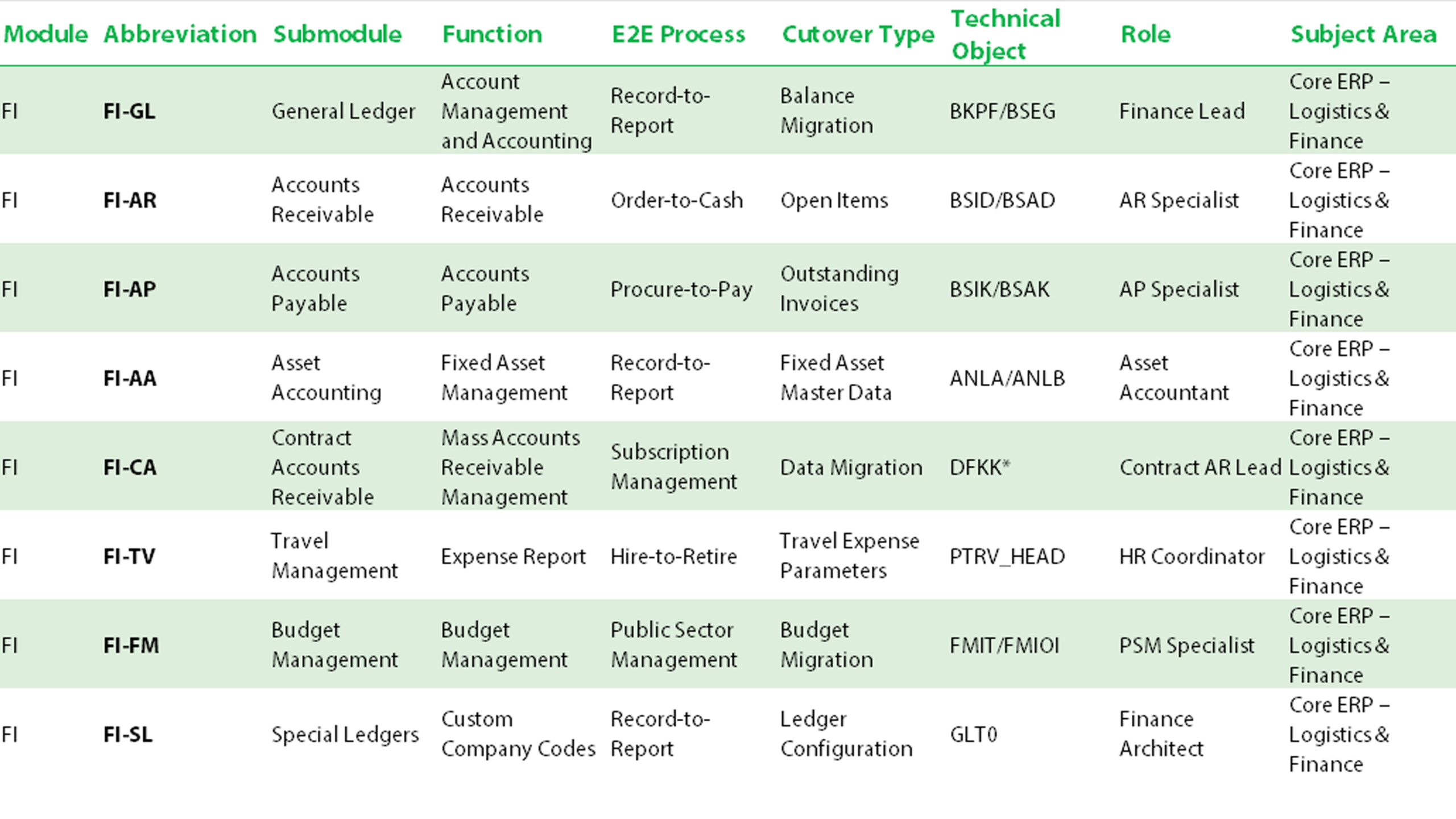
The SFAM™ is included in my book “SAP Cutover Management,” and you can download it for the price of a cup of coffee.