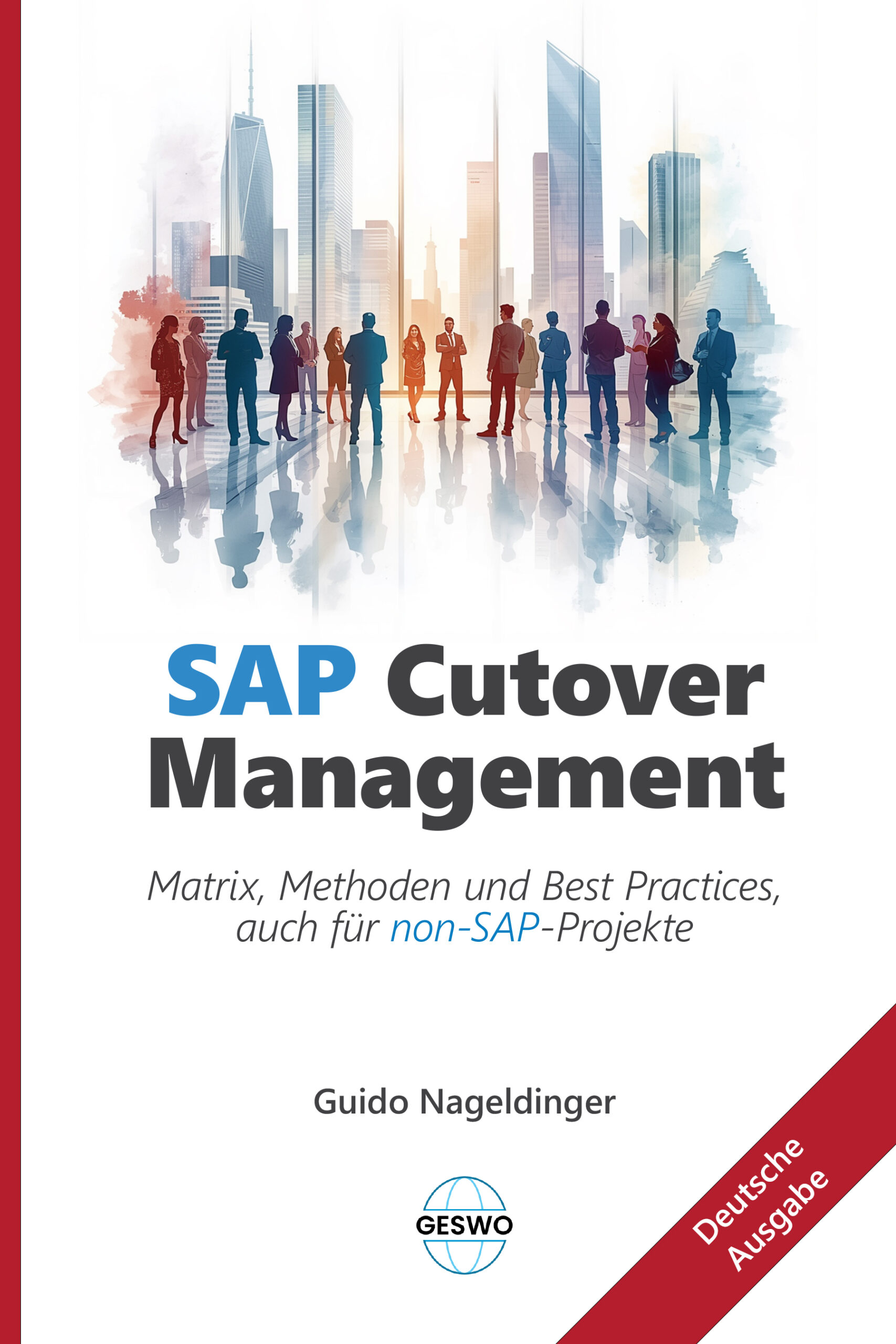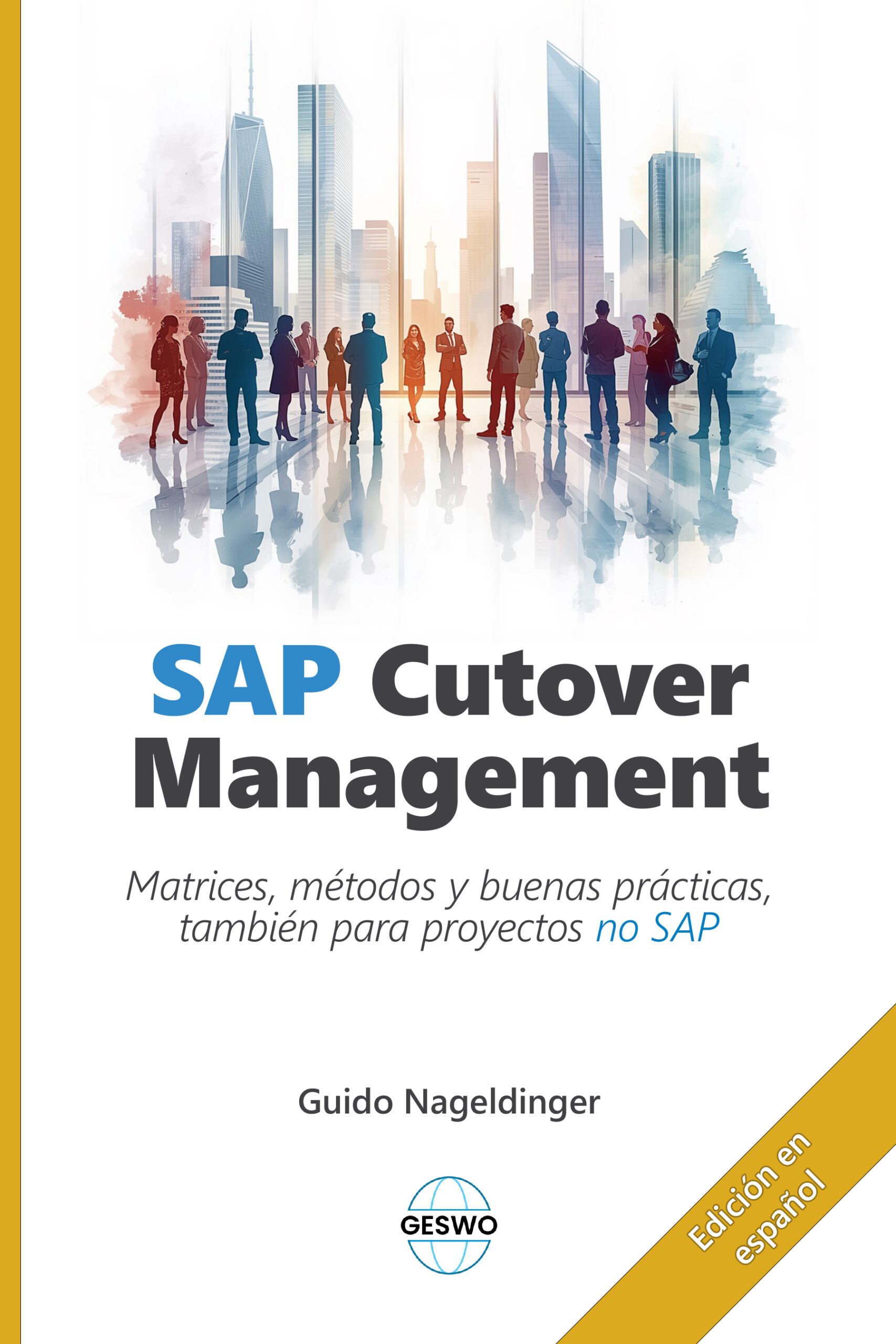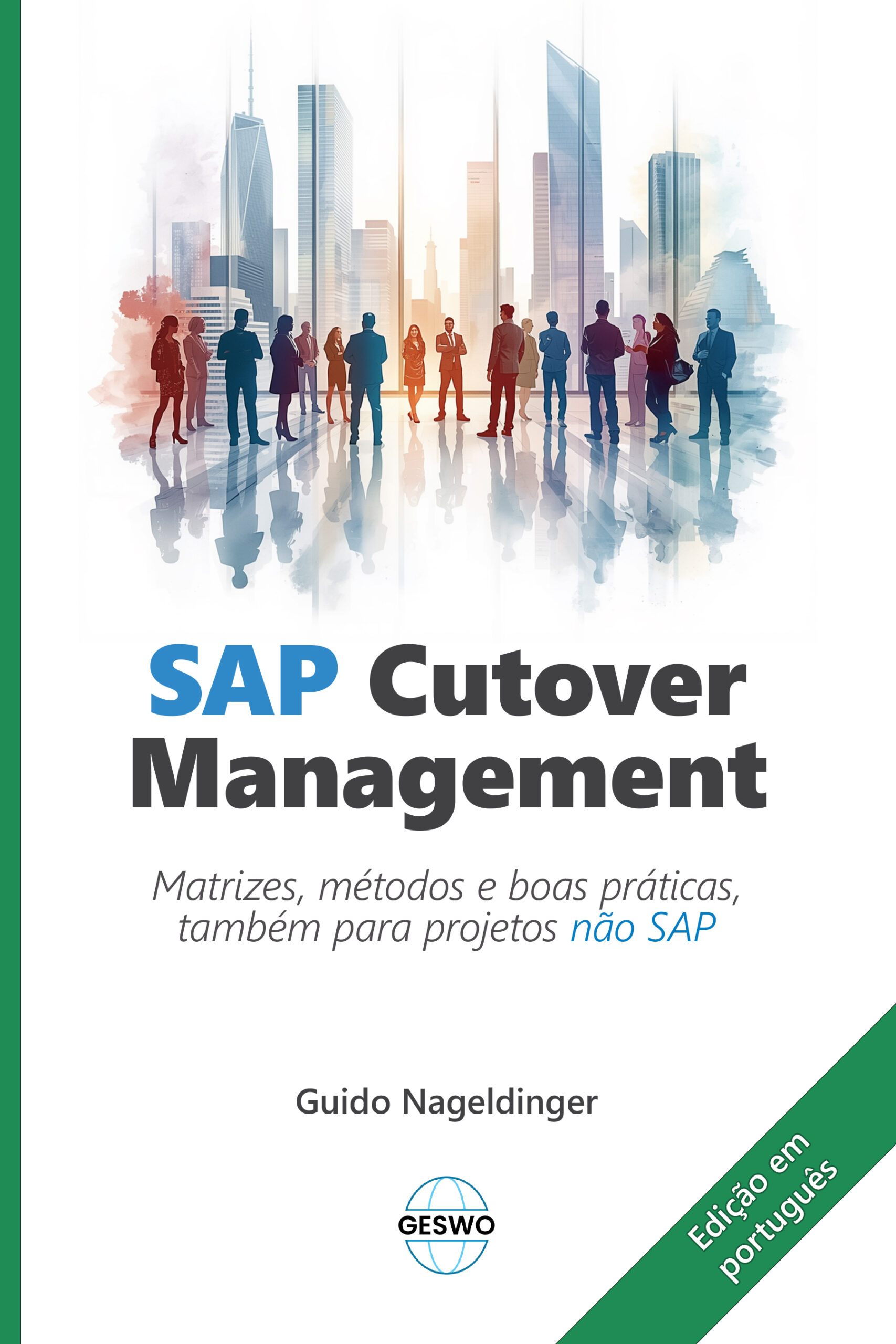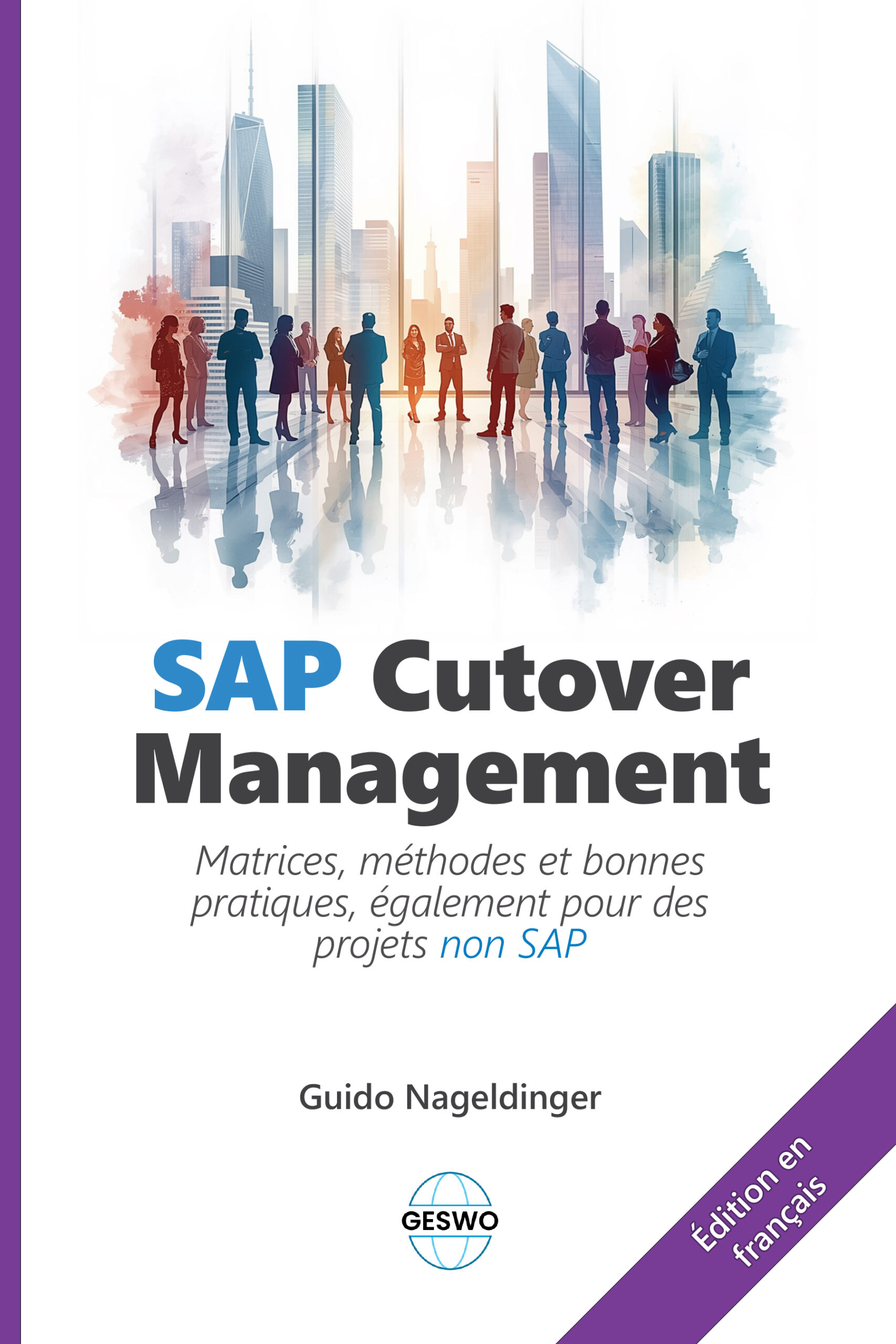
SAP Cutover Management: Matrix, Methods, and Best Practices, Including for Non-SAP Projects
by Guido Nageldinger
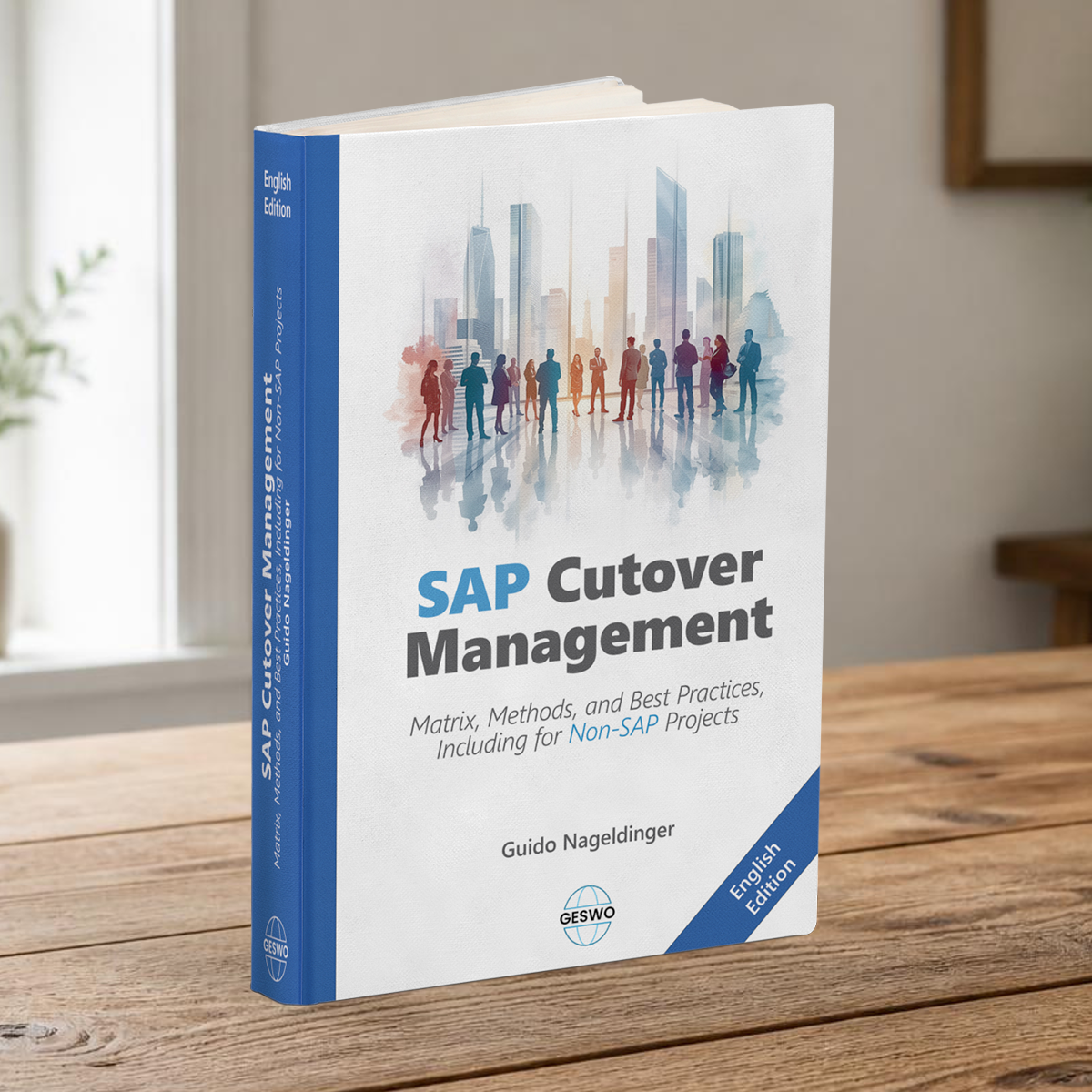
Book Description
This publication presents a comprehensive Governance system that integrates strategy, risk, Change, and communication management and ensures the operational controllability of the Cutover.
The Cutover Governance Matrix (CoGM™) forms the methodological foundation for planning, managing, and auditing complex SAP Go-Lives.
Supplementary models such as the Change Governance Matrix (ChGM™) and the Functional Assignment Matrix for SAP® (SFAM™ ) ensure that all cutover activities and their dependencies are taken into account.
Numerous templates, workshops, and field-tested Cutover Templates enable direct application in day-to-day project work.
A reference framework for project managers, SAP consultants, auditors, and architects who view Governance as the methodological foundation for successful transformations.
Choose your edition below, add it to the cart, and update quantities if required.
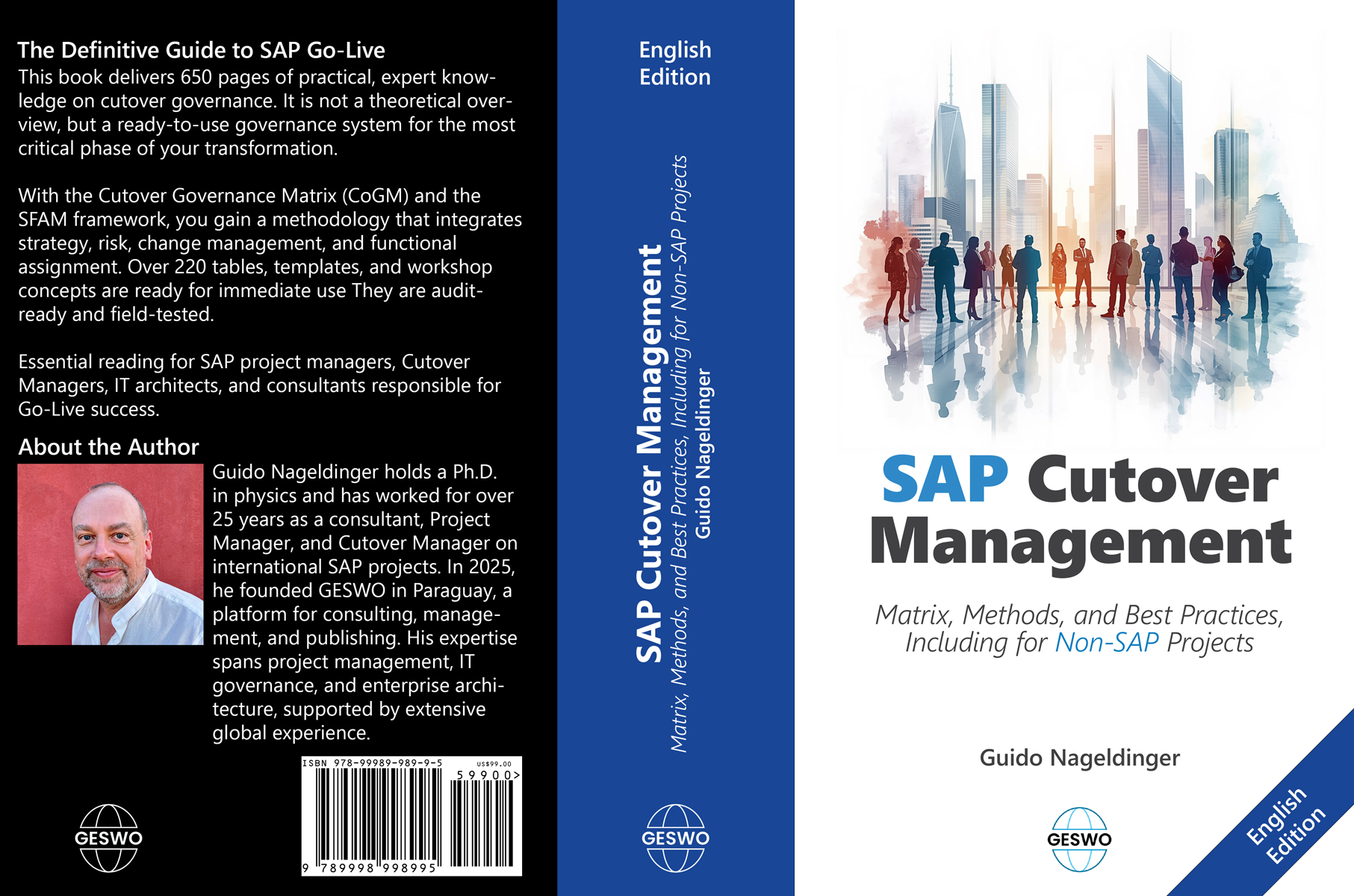
Cover
Contents
Foreword
Table of Contents
0 Cutover Governance Matrix
1 Go-Live Scenario & Timing
2 Stakeholder Management
3 Regulatory & Compliance Planning
4 Change Management
5 Governance & Escalation Logic
6 Communication & Reporting
7 Testing & Simulation
8 Cutover Planning and Execution
9 Risk & Fallback Strategy
10 Hypercare & Stabilization
Appendix
Appendix A: Change Governance Matrix (ChGM)
Appendix B: Cutover Governance Matrix (CoGM)
Appendix C: SAP Functional Assignment Matrix (SFAM)
Appendix D: Glossary Appendix
Appendix E: Bibliography Appendix
Appendix F: Figures Appendix
Appendix G: Tables Appendix
Appendix H: Definitions
About the Author
Foreword
Most IT projects—especially implementations and software development projects—alter a production system environment during Go-Live. Organizations face a twofold dilemma: On the one hand, changes must be implemented efficiently in accordance with ITIL; on the other hand, they must preserve the integrity of existing systems to comply with Service Level Agreements (SLAs).
Surprisingly, many companies still treat the cutover as a one-time “finish line” event: “We’ll do that over the weekend.” But I know from experience that this doesn’t work. I’ve seen projects where the Go-Live date simply “fell out of the blue.” When I asked for clarification, I heard responses like:
- “That’s just the best fit.”
- “It’s a management mandate.”
- “That’s how it was sold—now it has to work.”
What gets ignored in the process are factors such as global holidays, legal restrictions, local marketing campaigns, or cultural sensitivities in distributed teams. Sometimes the opposite even happens: A project is underway, but a Go-Live date is never set—out of fear of failure. Here, too, a robust Go-Live strategy is lacking.
And the deadline is just the beginning. A systematic inventory of cutover-relevant changes usually doesn’t exist—not to mention a change requirement mapping. Regulatory requirements are ignored, and business continuity measures are overlooked. Although SAP Activate offers a structured methodology with six phases (Discover, Prepare, Explore, Realize, Deploy, Run), there are serious gaps when it comes to Cutover:
- Cutover is only addressed marginally in the “Deploy” phase
- A dedicated methodology for complex scenarios is lacking
- The cutover point in time is misunderstood as a “flip of the switch”
- Tool Integration is fragmented—many teams improvise using Excel and email
And if there is a Cutover Manager—which is by no means a given—this person often becomes the one responsible for gathering all outstanding tasks leading up to Go-Live. Essentially, they’re the project’s “garbage collector,” tasked with sorting out the chaos a few months before the showdown.
All these examples show that in many projects, Cutover is underestimated, misunderstood, or simply improvised. The result is unnecessary risks, chaotic processes, and a Go-Live that relies more on chance than on strategy.
This is exactly where this book comes in. It views Cutover not as the “final act” of a project, but as a discipline in its own right that requires planning, methodology, and governance. Instead of fragmented Excel lists and spontaneous decisions, it offers a structured approach: from scheduling and change mapping to regulatory requirements and business continuity measures.
This book shows how Cutover can become a controllable, transparent, and repeatable process—and why it is just as critical to project success as architecture, test management, or change control. The chapters provide a step-by-step guide to the fundamentals, compliance, change governance, Communication, testing, planning, risk management, and Hypercare. Numerous models—such as the Cutover Governance Matrix (CoGM), the Change Governance Matrix (ChGM), and the SAP Functional Assignment Matrix (SFAM)—form the methodological framework. Over 200 tables and templates facilitate direct application in day-to-day project work.
This book marks the beginning of a more comprehensive offering on Cutover management. In addition to free resources such as a blog and forum—which promote knowledge sharing and community engagement—there will also be downloadable materials. For consultants, Project Managers, and companies seeking to delve deeper into the subject, we are developing advanced products and consulting solutions. Further information and materials will be available in the future on our editorial page at geswo.com as well as in the product section at products.geswo.com.
Key Thematic Areas
- Software Development & Engineering
- Enterprise Applications & Business Intelligence
- Projektmanagement (IT & Business)
Topics Covered
- SAP S/4HANA
- Cutover & Go-Live
- SAP Activate
- Cutover Planning and Cutover Template
- CoGM™ (Cutover Governance Matrix), ChGM™ (Change Governance Matrix), and SFAM™ (Functional Assignment Matrix for SAP®)
- Risk Management & Compliance
- Hypercare & Stabilization
- Migration, Testing & Reporting
- Governance Systems & Best Practices
Who is this book for?
Professionals, project managers, SAP consultants, cutover managers, architects, auditors, and academic readers in the field of IT Governance and transformation programs.
Details
Page Number
654 pages
Dimensions
- Paperback (B&W, Amazon/KDP): 6 × approx. 1,5 × 9″ (15,2 × approx. 3,8 × 22,9 cm)
- Hardcover (B&W, Lulu): 6 × approx. 1,7 × 9″ (15,2 × approx. 4,4 × 22,9 cm)
- Hardcover (Color, Lulu): 6 × approx. 2,1 × 9″ (15,2 × approx. 5,2 × 22,9 cm)
Weight
- Paperback (B&W, Amazon/KDP): approx. 1,08 kg
- Hardcover (B&W, Lulu): approx. 1,6 kg
- Hardcover (Color, Lulu): approx. 2,0 kg
Printing and Binding
- Paperback: Black and White (B&W), Perfect-bound
- Hardcover: Black-and-white (B&W) or color, hardcover
Language
English
Publication Date
July 2026
ISBN
See the table below
PDF Preview
Available Editions (ISBN Table)
| Sprache | Format | ISBN | Vertrieb | Status |
|---|---|---|---|---|
| German | Kindle E-book | 978-9998998902 | Amazon | available |
| German | Paperback (B&W) – Amazon/KDP | 978-9998998926 | Amazon | available |
| German | Hardcover (Color) | 978-9998998971 | Lulu | available |
| German | Hardcover (B&W) | 978-9998998964 | Lulu | available |
| German | Paperback (B&W) – Lulu Direct | 978-9998998933 | Lulu | available |
| German | E-book | TBD | Apple/Google | September 2026 |
| English | Kindle E-book | 978-9998998919 | Amazon | available |
| English | Paperback (B&W) – Amazon/KDP | 978-9998998940 | Amazon | available |
| English | Hardcover (Color) | 978-9998998988 | Lulu | available |
| English | Hardcover (B&W) | 978-9998998995 | Lulu | available |
| English | Paperback (B&W) – Lulu Direct | 978-9998998957 | Lulu | available |
| English | E-book | TBD | Apple/Google | September 2026 |
| Spanish | various | TBD | Amazon/Lulu/Apple/Google | September 2026 |
| French | various | TBD | Amazon/Lulu/Apple/Google | 2027 |
| Portoguese | various | TBD | Amazon/Lulu/Apple/Google | 2027 |
Distribution Channels
- Amazon (KDP)
- Lulu Direct
- Google Play Books
- Apple Books
- GESWO Direct Sales